Outcome Over Hours: Why Results-Driven Marketing Is the Future for Modern Brands
 Andrew MahoneyJuly 15, 2025
The End of the Billable Hour Era
Remember when agencies would bill you for every coffee break, brainstorming session, and "let me think about that" moment? Those days are rapidly becoming ancient history.
The marketing world is experiencing a seismic shift. The traditional agency model—where success is measured by hours logged and resources deployed—is giving way to something far more impactful: results-driven marketing that prioritizes outcomes over activity.
At 141 Creative, we've seen this transformation firsthand. Clients don't care how many hours it took to create that Instagram campaign or optimize their website. They care about one thing: Did it work?
Why Traditional Time-Based Marketing Is Breaking Down
For decades, the marketing industry has operated on a simple premise: time equals money. Agencies track hours, clients pay for those hours, and everyone pretends that time spent correlates perfectly with value delivered.
Here's the uncomfortable truth: it doesn't.
Consider these common scenarios:
- An agency spends 40 hours on a beautiful website that generates zero leads
- A team bills for 20 hours of social media management that produces gorgeous content but no conversions
- A client pays for extensive market research that never translates into actionable strategy
The fundamental problem is misaligned incentives. When agencies are rewarded for time spent rather than results achieved, efficiency actually becomes a financial penalty. Why solve a problem quickly when you can bill more hours solving it slowly?
The Results-Driven Revolution: What It Actually Means
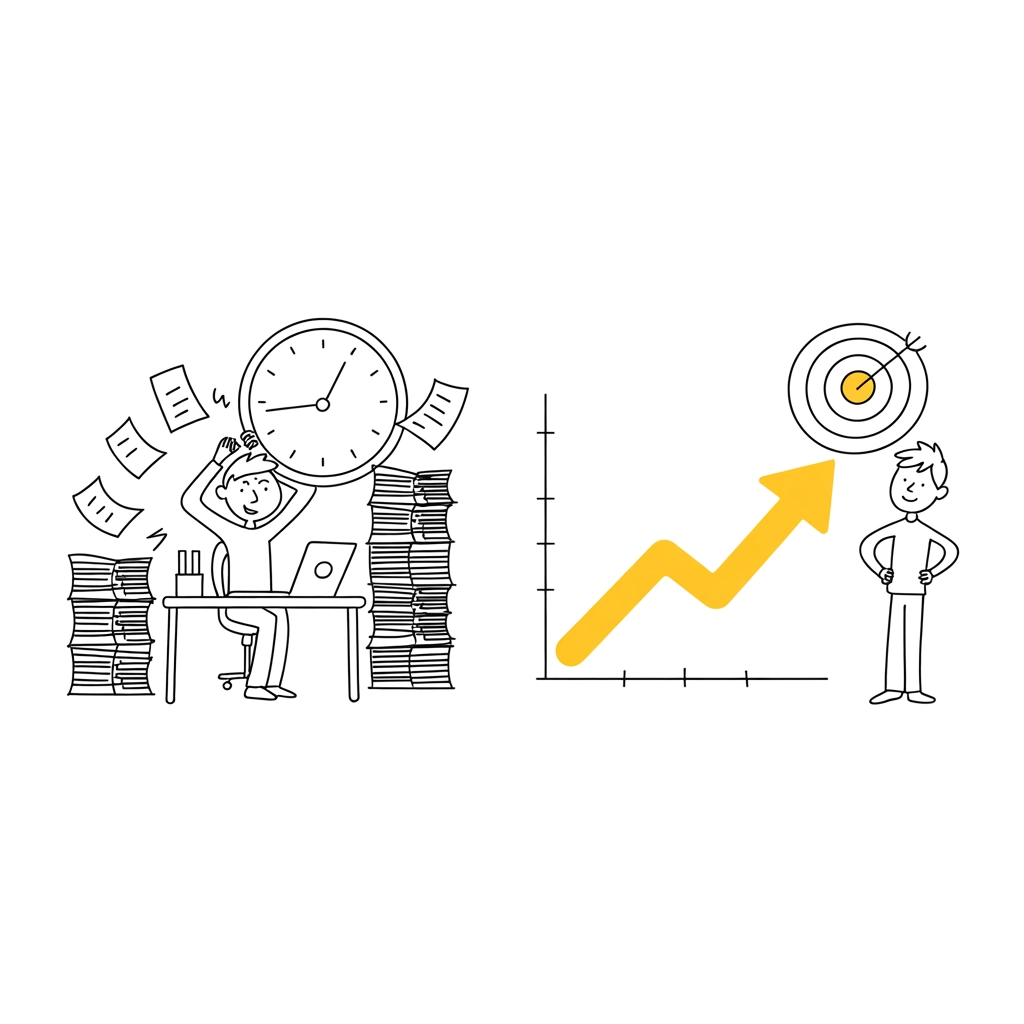
Results-driven marketing flips the traditional model on its head. Instead of focusing on inputs (hours, resources, activities), it zeroes in on outputs (leads, sales, revenue, growth).
This approach asks fundamentally different questions:
Traditional marketing asks: How many hours should we spend on this campaign? Results-driven marketing asks: What specific business outcomes do we need this campaign to generate?
Traditional marketing measures: Time spent, tasks completed, deliverables produced Results-driven marketing measures: Leads generated, conversion rates, customer acquisition costs, ROI
The shift isn't just semantic—it's philosophical. Results-driven marketing recognizes that clients don't buy marketing services; they buy business growth. And agencies should be compensated based on their ability to deliver that growth.
Five Undeniable Benefits of Results-Driven Marketing
1. Perfect Alignment of Goals
When agencies get paid based on performance, their goals instantly align with their clients'. Suddenly, everyone is working toward the same objective: measurable business growth. No more conflicts between billable hours and efficiency.
As one of our clients recently put it: "For the first time, I feel like my marketing team is genuinely invested in my company's success—not just in keeping me as a retainer client."
2. Superior Accountability and Transparency
Results-driven marketing forces radical transparency. When success is measured by concrete outcomes, there's nowhere to hide behind vague metrics or busy work.
This approach demands clear reporting on what matters most: Did we increase your qualified leads by 30% as promised? Did we reduce your cost per acquisition by 25%? Did we boost your conversion rate from 2% to 5%?
Every dollar spent becomes directly traceable to business results, creating unprecedented accountability in the client-agency relationship.
3. Data-Driven Decision Making
When outcomes take center stage, data naturally follows. Results-driven marketing requires robust tracking and analytics to measure performance accurately.
This data-centric approach eliminates gut feelings and subjective opinions. Every decision becomes testable against actual performance metrics:
- Which headline generated more clicks?
- Which offer drove more conversions?
- Which channel delivered the lowest customer acquisition cost?
The result is continuous optimization based on real-world results rather than theories or assumptions.

4. Resource Optimization
Perhaps the most immediate benefit of results-driven marketing is the ruthless elimination of wasted effort. When agencies are incentivized to achieve outcomes rather than bill hours, they naturally focus on high-impact activities and cut everything else.
That means:
- No more vanity projects that look impressive but generate no results
- No more excessive revisions when the first version was already effective
- No more spreading efforts across too many channels when data shows where the real returns are
5. Scalable Growth Through Performance
Results-driven marketing creates a virtuous cycle: as campaigns generate better outcomes, they justify larger investments, which in turn produce greater results.
This scalability simply isn't possible in the traditional model, where scaling typically means linearly increasing hours (and costs) without necessarily improving outcomes.
How Modern Brands Are Implementing Results-Driven Marketing
Transitioning to a results-driven approach requires fundamental changes to how marketing is structured, executed, and measured. Here's how forward-thinking brands are making the shift:
Setting Meaningful KPIs
The foundation of results-driven marketing is identifying the right key performance indicators. These aren't vanity metrics like page views or social media followers, but business-critical outcomes:
- Cost per qualified lead
- Customer acquisition cost
- Customer lifetime value
- Conversion rates at each funnel stage
- Revenue generated per marketing dollar
The most successful brands establish these KPIs before a single dollar is spent on marketing activities.
Creating Accountability Systems
Results-driven marketing requires clear accountability frameworks that connect every marketing activity to expected outcomes. This means:
- Documented performance expectations for each campaign
- Regular review cycles to assess performance against targets
- Clear protocols for optimizing underperforming initiatives
- Performance-based compensation structures for agencies and vendors
Building Data Infrastructure
You can't manage what you don't measure. Results-driven marketing demands robust analytics capabilities:
- End-to-end tracking from first touch to final conversion
- Attribution modeling to understand which channels drive results
- Dashboards that provide real-time visibility into performance
- Testing frameworks to continuously optimize campaigns
Real Results: Case Studies in Outcome-Based Marketing
The E-Commerce Revolution
One of our e-commerce clients previously worked with an agency that charged by the hour for social media management. After six months and thousands of dollars, they had beautiful content but anemic sales.
When they switched to our results-driven approach, we restructured their entire program around one KPI: return on ad spend (ROAS). Every creative decision, every platform choice, every audience segment was evaluated based on its impact on ROAS.
The result? Within three months, their ROAS jumped from 1.2x to 4.8x—a 400% improvement with the same monthly budget.
The B2B Lead Generation Machine
A B2B software company came to us frustrated after spending $15,000 monthly on content marketing that produced mountains of blog posts but few qualified leads.
We rebuilt their program around a single metric: cost per qualified opportunity. This shifted focus from content volume to content performance. We created less content but invested heavily in distribution and conversion optimization.
Within six months, their cost per qualified opportunity dropped from $3,200 to $870, allowing them to triple their pipeline without increasing their budget.
Why Results-Driven Marketing Is the Future (Not Just a Trend)
The shift toward results-driven marketing isn't simply a temporary trend—it's a fundamental evolution of the industry driven by several irreversible forces:
1. Increased Market Pressure
As competition intensifies across virtually every industry, businesses can no longer afford marketing that doesn't deliver measurable returns. The luxury of unmeasured brand awareness campaigns is disappearing as boards and investors demand clear ROI.
2. Advanced Measurement Capabilities
The technical barriers to results-driven marketing are falling away. Today's analytics platforms, attribution models, and testing tools make it possible to connect marketing activities directly to business outcomes with unprecedented precision.
3. Client Demand for Transparency
Modern brands are increasingly sophisticated about marketing and unwilling to accept black-box approaches. They expect complete visibility into what's working, what's not, and why.
4. Economic Uncertainty
In uncertain economic times, businesses prioritize predictable returns on their investments. Results-driven marketing offers this certainty by directly tying marketing spend to business results.
Making the Transition: How to Shift to Results-Driven Marketing
For brands looking to embrace the results-driven approach, the transition doesn't have to happen overnight. Consider these steps:
- Audit your current marketing metrics and identify gaps between what you're measuring and what actually drives business growth
- Establish clear KPIs that directly connect to revenue and profitability
- Review agency relationships and consider how incentives might be restructured around outcomes
- Invest in measurement infrastructure to enable accurate tracking of performance
- Pilot a results-driven approach with a specific campaign or channel before rolling it out broadly
The Bottom Line: Outcomes Trump Activities Every Time
The future of marketing belongs to brands and agencies that focus relentlessly on results rather than activities. As we like to say at 141 Creative: "We don't sell hours, we sell outcomes."
In a world where marketing budgets are under constant scrutiny and businesses need every dollar to work harder, the results-driven approach isn't just preferable—it's essential. The question isn't whether to make the shift, but how quickly you can do it before your competitors beat you to it.
Ready to put outcomes at the center of your marketing strategy? Let's talk about what results-driven marketing could look like for your brand.