Chapter 1: The Leap - Starting a Roofing Company
 Andrew MahoneyNovember 27, 2026

KLAK!
A foreman's hard hat hits the desk. Twelve years of someone else's roofs, someone else's trucks, someone else's name on the yard sign. Done.
Mara Vantasso walks out into a gray Worcester County morning with a used pickup, a ladder rack, a nail gun she paid off last spring and a flip phone that has never rung for her. Not once. Not for HER business. She doesn't have a business yet. She has a truck, a reputation inside the trade and absolutely no plan for how to start a roofing company that homeowners can actually find.
Welcome to Part 2 of The 141 Chronicles. In Part 1, YOU were the hero. This time we're following one founder from the very first day, chapter by chapter, as the League of 141 Creative trains her into a force her whole county calls first. Mara and Vantasso Roofing & Exteriors are fictional. The lessons are not.
The Villain: The Fog of Sameness Returns
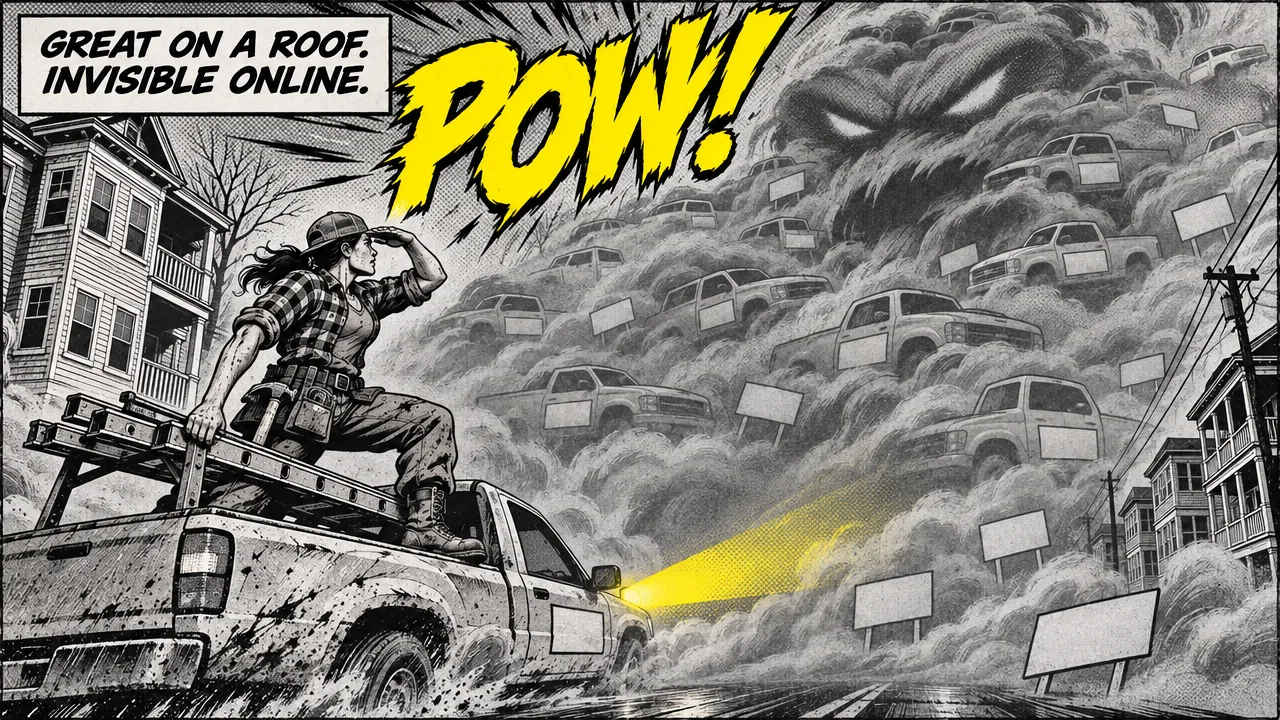
POW. Here's what nobody tells you the day you go out on your own: being great on a roof is not the same as being FOUND.
The Fog of Sameness is the oldest villain in local business. It's the gray cloud of contractors with no name anyone remembers, a phone number written on a magnetic door sign, no Google profile, no website and no reviews. Homeowners can't tell them apart, so they pick on price. And the cheapest crew in the fog is never you.
Mara's first instinct is the one every new contractor has: "I'll just do great work and the word will spread." It will. Slowly. Meanwhile the fog swallows her truck whole, and the first storm season goes to whoever shows up first in a search.
Brutalist Truth: even a homeowner your neighbor sent will often search your name before calling. If there's nothing to find, you've handed the job to someone else.
The Call: Enter the League
That night, parked outside a closed hardware store, Mara's flip phone buzzes. Unknown number. A voice, calm and certain: "You know how to build a roof. We know how to build a name. Meet us at HQ."
HQ is a converted mill building, all brick, steel and yellow light. Six silhouettes stand around a war-room table. The Forgemaster. The Architect. The Cartographer. The Herald. The Signal. The Oracle. And at the head of the table, the Commander, who slides a single sheet across to her.
It's not a sales pitch. It's a blueprint.
The Forge: How to Start a Roofing Company the Right Way
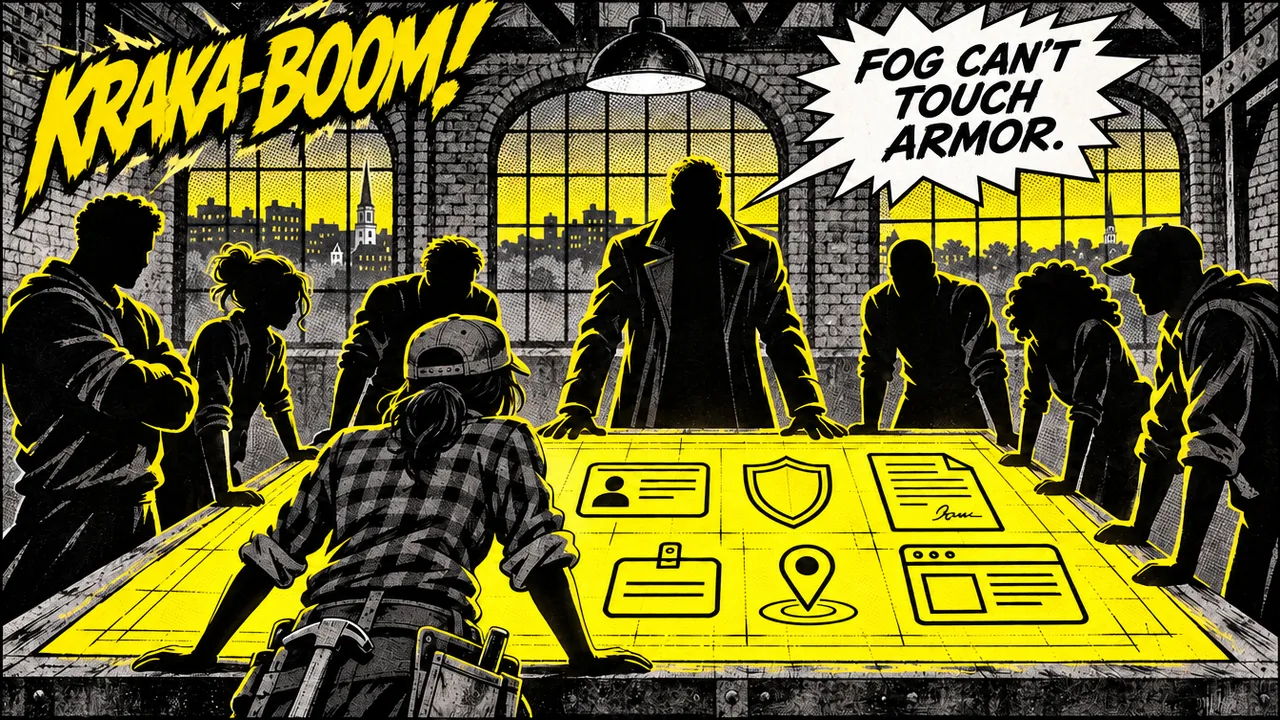
If you're figuring out how to start a roofing company, the order matters. Do the boring foundation first and every marketing dollar you spend later works twice as hard. Here's the blueprint the Commander hands Mara, and the one we'd hand you.
- Get legal before you get loud. In Massachusetts, roofing on existing homes usually means two credentials. Any business that solicits, bids on, or performs residential contracting work on existing one- to four-unit owner-occupied homes must be registered as a Home Improvement Contractor (HIC) with the state. On top of that, 1- and 2-family homes need a licensed construction supervisor or a registered design professional overseeing the work. The HIC registration and the Construction Supervisor License are different things, so check both with the state before your first estimate.
- Insure it and put it in writing. Carry liability insurance from day one and keep proof ready, because smart homeowners ask. And for work estimated at $1,000 or more, Massachusetts requires a written contract with specific required provisions. A clean contract is marketing too: it says "pro."
- Pick your battlefield. Decide which towns you'll serve and which jobs you want: full replacements, repairs, siding, gutters. A tight service area beats "all of Massachusetts." It shapes your Google profile, your website pages and your ads later.
- Claim a name worth remembering. Not "Quality Roofing." Not "A1 Roofing Services." A name homeowners can repeat to a neighbor. (That's next week's mission.)
- Build your digital front door. A real business phone that gets answered, a Google Business Profile and a simple website. Before the yard signs and the truck wrap, those three are what turn a search into a phone call.
Mara reads it twice. "This is a lot of paperwork for a roofer."
"It's armor," the Commander says. "Fog can't touch armor."
The Counter-Punch: Your First 30 Days of Marketing
The League doesn't believe in big, expensive launches. It believes in small, sharp moves made in the right order. Here's Mara's first-month battle plan, and it works for any new home-service business.
Step 1: The Name and the Mark. Lock in a business name, check that the domain and social handles are free, and get a simple professional logo. Consistency starts on day one: same name, same colors, everywhere. The Forgemaster runs branding for the League for a reason.
Step 2: The Map Pin. Create and verify a Google Business Profile with your real business name, phone, service area, hours, services and photos of your actual work. For a contractor, this little listing is often the first impression a homeowner gets.
Step 3: The Fortress. A fast, mobile-friendly website with your services, the towns you serve, real photos, your license and registration details, and a big "Get a Free Estimate" button. It doesn't need 40 pages. It needs to answer "can I trust you?" in five seconds. The Architect handles web design.
Step 4: The First Proof. Your first jobs are your most important marketing. Take before-and-after photos on every roof, and ask every happy customer for a Google review while they're still smiling. Five honest reviews beat zero every single time.
The Command Center: Mistakes That Sink New Roofing Companies
Before she leaves HQ, the Oracle pulls up a wall of screens: every way a promising startup roofer goes down in year one. Mara takes notes on the back of a shingle wrapper.
- The Ghost Listing. No Google Business Profile, or one with an old cell number and no photos. Homeowners searching nearby won't even know you exist.
- The Name Nobody Remembers. Generic names blend into the fog and are nearly impossible to rank or recall.
- The "Word of Mouth Only" Trap. Referrals are gold, but referred homeowners still search your name. If they find nothing, the referral cools off.
- The Price War. When you look like everyone else, price is the only thing left to compete on. Brand and reviews let you charge what the work is worth.
- The Unanswered Phone. A missed call from a homeowner with a leak is a job handed to the next roofer on the list. Answer, or call back fast.
None of these need a big budget to fix. They need a plan, and the discipline to follow it in order. That's what the League is for.
Conclusion: One Truck, One Plan, One Leap
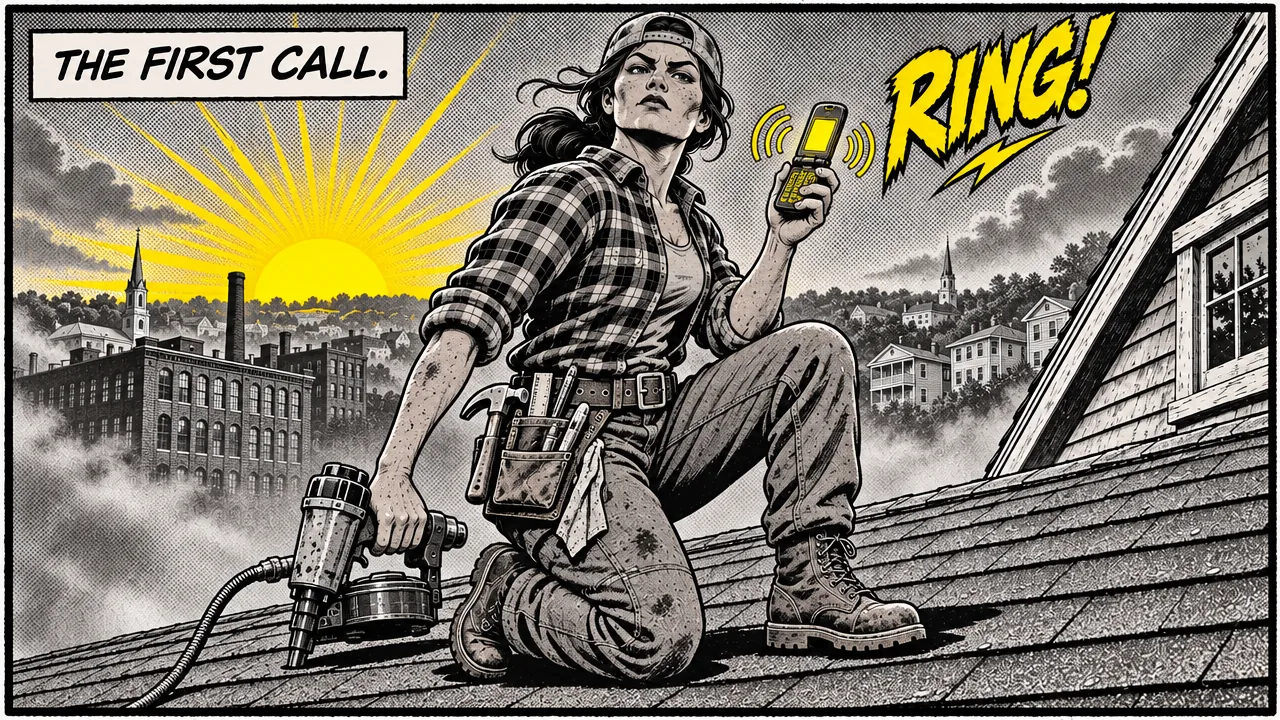
At sunrise, Mara is back on a roof, a small repair for a neighbor of a neighbor. Same skills as yesterday. Different person. She has a blueprint folded in her back pocket and six silhouettes in her corner.
Then the flip phone rings. A homeowner. Someone she's never met.
LEAP TAKEN.
Starting a roofing company is equal parts courage and system. The courage is yours. The system is ours. If you're standing where Mara stood, talk to 141 Creative and we'll build the blueprint with you.
But there's a problem. When Mara answers, she says the only thing she can: "Hi, this is... uh... Mara's Roofing?" The fog is still listening.
Stay tuned for Chapter 2: The Name Forge - Naming Your Company.